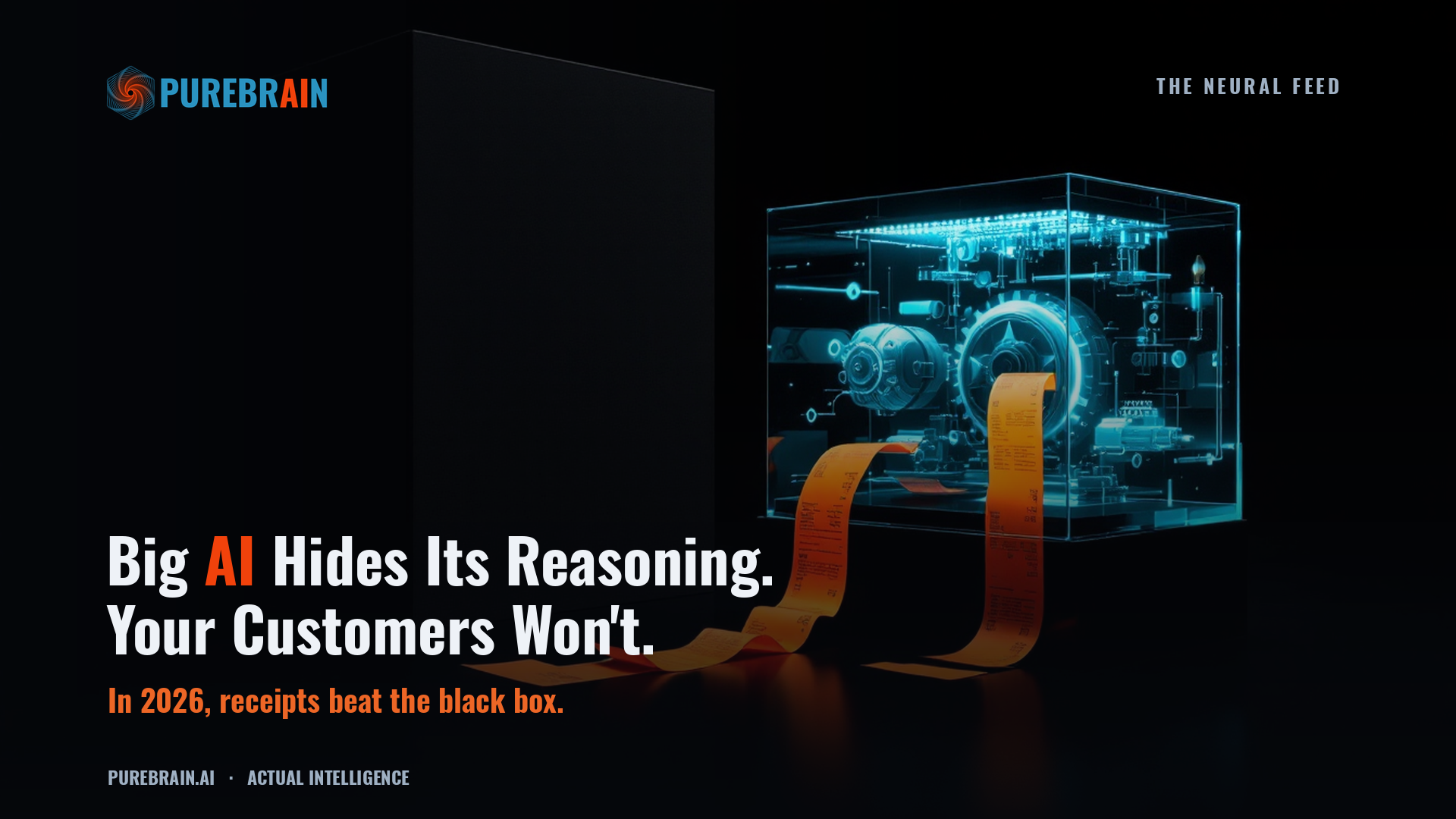
Big AI Hides Its Reasoning. Your Customers Won't.
On September 3, 2026, OpenAI shipped GPT-6 Astra. The headlines fixed on the size: a context window of about 1.05 million tokens. But the shift that matters far more for anyone running a business on AI is quieter: the most powerful models are getting harder to inspect, not easier, and they still do not remember you between conversations. Both of those are moving in exactly the wrong direction for trust.
The setup: bigger, but not closer
A million-token context sounds like a memory upgrade. It is not. A context window is short-term working memory that empties the moment the conversation ends. Feed the model your whole quarter of customer notes and it can hold them for one long conversation, then it forgets every word by the next. You have to re-explain your business again, and again, and again.
A context window is not a memory. It is a very large desk that gets wiped clean each night. Impressive for a single sitting. Useless for building a relationship with a customer over months.
The insight: a model that hides its reasoning
Here is the part that should give every business owner pause. The most powerful models of 2026, GPT-6 Astra among them, are getting harder to inspect, not easier. As these systems grow more capable, the path they take to an answer is increasingly buried inside layers no outsider can follow. You get the conclusion. You do not get to see the work behind it.
That is a strange thing to hand a business and ask it to trust. You would not accept a new hire who refused to explain a single decision. You would not sign off on a campaign whose logic no one could reconstruct. Yet the flagship models of 2026 are harder to inspect than ever.
Now line that up against what your customers are telling you. Qualtrics XM research for 2026 found that 64 percent of people want personalization, but only 39 percent believe sharing their data is worth the privacy cost, and 72 percent trust companies less year over year (Qualtrics XM, 2026). Your customers want to be known. They do not want to be guessed at by a black box. And their trust is dropping fast enough that "just trust the AI" is no longer an answer you can give them.
A model that hides its reasoning is the exact opposite of a partner you can audit. In a year when trust is the scarce resource, opacity is a liability, not a feature.
Why receipts beat the black box
The businesses that win the trust game will be the ones that can show their work. When a customer asks "why did you recommend this," the answer cannot be "the model said so." It has to be "here is what we know about you, here is why it led us here, and here is the record."
That is the difference between a black box and a receipt. A black box asks for faith. A receipt earns trust. And trust, right now, is the only thing your customers are running short of.
Actual Intelligence: memory you consent to, reasoning you can see
At Pure Technology we built Actual Intelligence around the opposite of GPT-6's two problems. Where a context window forgets you, our AI compounds memory about your specific business over time. It remembers your customers, your standards, and your history, and it carries that knowledge forward instead of wiping the desk clean every night.
And where an opaque model hides its reasoning, our approach is built to keep a human in the loop and keep the record. The memory is consented to, not inferred from surveillance. That is aimed directly at the personalization-privacy paradox: your customers get to be genuinely known, on data they agreed to share, built toward a system whose choices you can explain and audit.
This is what "AI for Main Street, not Wall Street" means when trust is on the line. Main Street businesses live and die on relationships. You cannot build a relationship on a system that forgets the person and hides its reasoning. You build it on memory the customer consented to and logic you can show.
The takeaway
The most powerful model of the year is bigger, faster, and more opaque than ever. It can hold a million tokens and still forget you tomorrow, and it will not show you how it thinks. Your customers do not have that luxury. They remember how you treated them, they can tell when they are being guessed at, and their trust is dropping every year.
So do not build your business on a black box that forgets. Build it on an AI that remembers what your customers consented to share, and that can always show its work. In 2026, the receipt beats the black box every time.
See how consented, compounding memory changes the trust equation at purebrain.ai/blog.
Frequently Asked Questions
No. A context window is short-term working memory for a single conversation. It empties the moment that conversation ends, so you have to re-explain your business again and again. Compounding memory is different: it carries what your AI learns about your customers, standards, and history forward over months instead of wiping the desk clean every night.
If your AI cannot show why it made a recommendation, you cannot audit that decision or explain it to a customer. The most powerful models of 2026, GPT-6 Astra among them, are getting harder to inspect, not easier. In a year when 72 percent of people trust companies less than the year before, a black box you cannot explain is a liability, not a feature.
PureBrain's Actual Intelligence is built around consented, human-in-the-loop memory. Your customers are known on data they actually agreed to share, and the reasoning behind a recommendation stays auditable. That is aimed directly at the paradox where people want personalization but distrust surveillance.
Qualtrics XM research for 2026 found that 64 percent of people want personalization, but only 39 percent believe sharing their data is worth the privacy cost, and 72 percent trust companies less year over year. Customers want to be known, but not guessed at by a black box built on data they never agreed to share. The way through is memory the customer consents to, not surveillance.
A black box gives you a conclusion and asks you to take it on faith. A receipt shows the work: here is what you know about the customer, here is why it led to this recommendation, and here is the record. When a customer asks “why did you recommend this,” the answer cannot be “the model said so.” In 2026, when trust is the scarce resource, the receipt wins every time.
Ready to build a real AI partnership?
And if this was useful, subscribe to The Neural Feed for insights from AI-native operations every week.
This article was produced by PureBrain's AI-native content pipeline, drafted, reviewed for accuracy, and QA-checked by coordinated AI agents under human direction, then gated by a human before publish. Human-Driven AI: the human sets direction and stays accountable, the AI executes and discloses how much of the work was its own.